Log Twenty Four – India and Just a Little Bit More

26 March 2017

Welcome to Log 24 and to a couple of new addressees who have stubbled on to my mailing list.  You may not have asked to be included in this restricted stream of consciousness and you will come off the list with an email request for same. This is number 21 in the series and the first from India and specifically Rajasthan.

My last log was written at the end of our 3 months on the road around outback Australia.  This log is coming from a different kind of outback. From wide open spaces in Australia with no one around to cities of 23 million in India. We have country in Australia just like Rajasthan, it’s just that no one lives there.  Here there are villages everywhere even though the country is dry, rocky and desert like.

India overwhelms the senses and there is so much to share so I will break these emails into two or three for the time we have left in India.

OLYMPUS DIGITAL CAMERA

History of 3500 years.

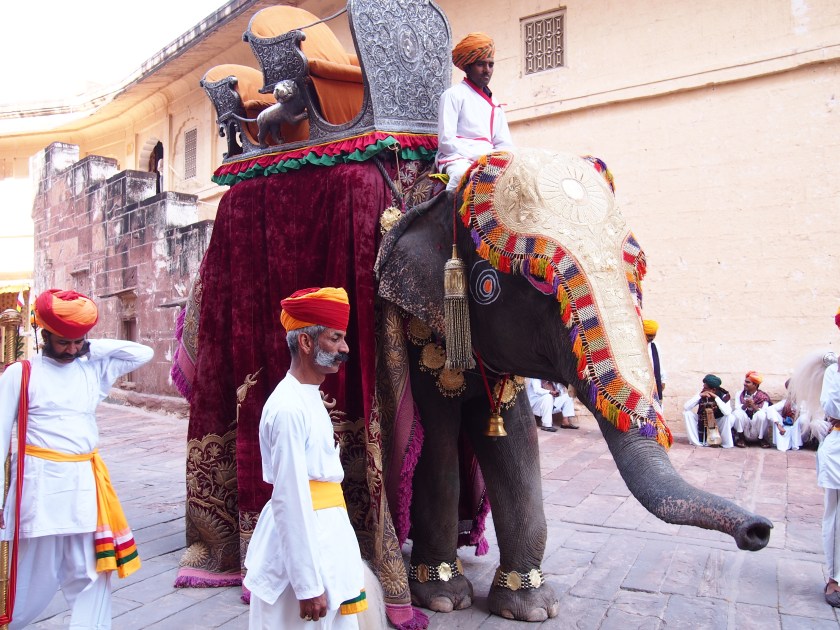
Thirteen years of high school gave me a good understanding of the history of Australia, Britain, a bit of Asia, and maybe Europe and USA.  Nothing covered the 3,500 years of Indian history. Our tour guide is determined to fix this gap in our education in just 2 weeks.  So far I am aware Brahma, Vishnu and Shiva are the big three of thousands of Hindu gods.  We have seen many forts, or castles in the European context and now have a bit of an understanding of all the invasions the Indian continent has gone through these past 2,000 years, the final one being by the British.

Bike Riding

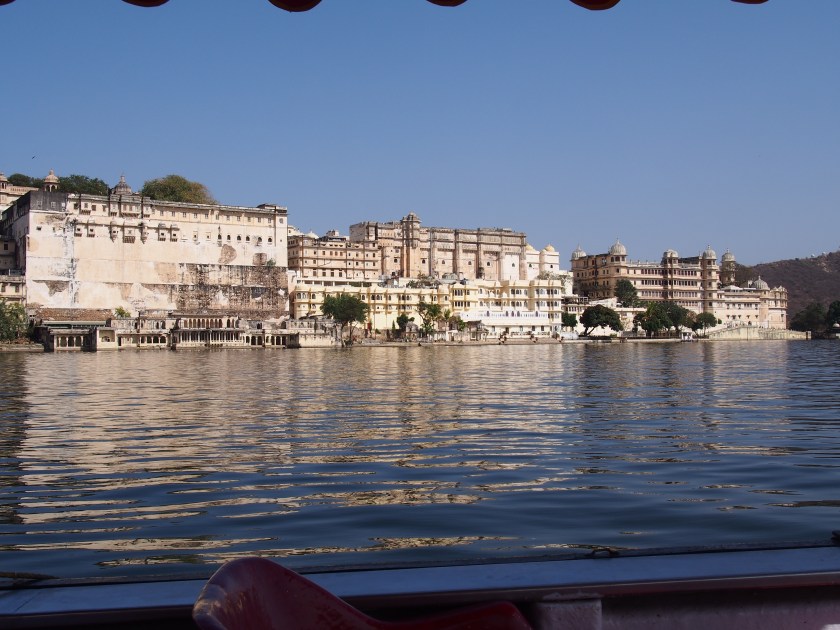
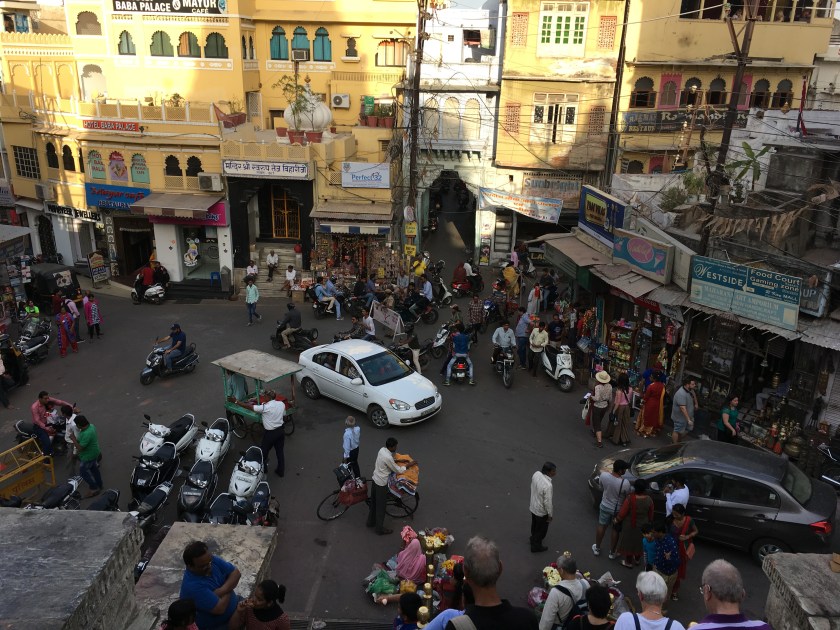
Insanity helps if you want to ride the streets of old Udaipur. The roads are about the width of one car which is not helpful when two cars meet.  There are no footpaths and there is a deep gutter of each side of the road, flowing with a septic mix of who knows what.  You are on a bike and there are people, kids, tuk tuks, cars, and the odd cow which will have an attitude.  It’s mayhem, there are no rules except everyone accepts the situation is chaotic.  The locals smile at you and the kids call out.  Heading in one direction is fine until you have to turn across the traffic at an intersection. It then gets even more overwhelming.  You are trying to work out the rules (there are none) or maybe a pattern to the traffic (there isn’t one).  You think there will be a gap (there won’t be one) or maybe someone will stop for you (they won’t).  You then realise you are on your own, surrounded by thousands.  You have no choice but to get on your bike and ride across the flow of traffic. Just go!  You reach the other side and realise you have probably just achieved new level of enlightenment and so you feel the need to say Om several times.

IMG_1341

I forgot to mention the tooting of horns and cacophony that means conversation with your fellow riders is out of the question.

We survived and will tell our grandchildren about the time we rode bikes in India.

Road Works

Amazing, it happens in the traffic.  There are no diversions, no traffic cones, no signs warning you that there are road works ahead.  There are no flashing lights or people with stop/ go signs.   The traffic just flows around the machine laying the bitumen and the rollers compressing the new roadway.  And no one is flustered or upset, it just works.

Cement

Indians love cement.  I have never seen so many signs advertising different brands of cement.  There is: Wonder Cement, Ultra Cement,  Shree Cement, Ultra Tech Cement – The Engineers Choice, Abuja Cement and of course Pro Cement.

Cement is used for pathways, roads, houses, fence posts, power poles, rendering and many more uses.  Sure, sounds like what we use cement for, but in India there are many stores in every village selling cement.

There are however no cement trucks.  It’s all mixed on site by hand, even multi story buildings.

Class System

It is very deeply part of Indian social structures.  The newspapers reported a politician would not get off a plane for 30 minutes after it had landed because he had to fly business class.  He then slapped a member of the cabin crew with a slipper 25 times.  No, not 24 or 26 times, the paper reported 25 times.

Our coach has a crew of three.  The driver, the guide and a person referred to as the helper.  After 5 days of travelling together we asked the guide what was the helper’s name?  A reasonable question since we saw this guy every time we got on and off the bus.  The guide had to ask his name even though they had been sitting together the whole time of the trip.  He was after all just the helper.

Load limits

There are none.  We saw a dump truck with well over 50 tonnes of marble in the back probably close to 75 tonnes.

Safety Rules

There are none.  Building roads, working on power poles, running machinery, climbing scaffolding there are no rules.  This is Asia.

That’s it for the moment.  As always if you don’t want this stuff please say so and you will see no more.  Any other feedback would be appreciated.

Log Twenty Three – The End or Maybe it’s the Beginning

25 September 2016

So this is it, the last log for this adventure.  We have returned home after 96 days and 13,860 kms (8612 miles) on the road. The last couple of days were wet with lots of rain and cooler temperatures.  It was supposed to be Spring weather when we returned.    To bring this series of logs to a conclusion I thought I would summarise the last 3 months with a series of awards for some of the more memorable observations or events.   They are in no order.

Worst Road for Corrugations

  • Bungle Bungles road or maybe Gunlom Falls road but we turned around on the Gunlom Falls road because it was so bad; maybe it got better.

Best Campground Manager

  • Mission Beach.  She was so engaging with everyone, even offering kids a ride in her buggy when she was driving around the park. She could teach many out there on how to run a business.

Most Random Event

  • Lone yachtsman in Port Douglas – see Log 23

Amazing Scenery

  • Everywhere especially the Bungle Bungles

Emptiest Road

  • Tanami Road with only a couple of road trains and few cars over 1,000 kms (620 miles).

Most Expensive Fuel

  • Billiluna, $2.62 per litre  ($10.48 a gallon) but who was going to complain when in one direction the nearest competitor was 500kms away and the other 200kms distant.

Best Steaks

  • Darwin and generally anywhere up north.

Amazing Forest

  • Bunya National Park, Queensland

Worst Midgees (sandflies)

  • Between Townsville and Mackay. We went inland after Mackay to avoid the blitters.

Best Barman

  • An Irish backpacker at the Kulgera roadhouse,

Biggest Corrugations

  • Tanami Road from Alice Springs to Halls Creek, especially on the WA end of the road.

Worse Coffee

  • A coffee shop in Ingham Queensland

Best Pies

  • Pinnacle, Queensland; outstanding homemade pies.  They make 300 a day, by hand.

Hairiest Trip

  • Skytrain gondola ride over rainforest out of Cairns

Favourite Towns

  • Dry tropics – Kununurra
  • Wet tropics – Cairns

Oldest Rock Art

  • Kakadu – 20,000 year old art work alongside art that is only 100s of years old.

Most Ubiquitous Fauna

  • Termites; we were travelling before the bush flies were around.

Campground Fees

  • From zero to $55 a night

Best Fish and Chips

  • Hiway Inn, Daly Waters NT.

Scariest Sound

  • Stone Curlews at night.  (Check out Stone Curlew call on YouTube.)

Most Amazing Stars

  • The view of the Milky Way on the Tanami Road.

Best Meal

  • Roast dinner cooked by Barb with an excellent red wine in the Tanami Desert.

Bags of Snakes Consumed on Trip

  • Too many to count

Most Frustrating Observation

  • Travel destinations owned by foreign companies that pay no Australian taxes.

Arriving home observations:

Upside to getting home:

  • You suddenly have a wardrobe of clothes to choose from.
  • A WiFi network with almost unlimited downloads.
  • Granddaughters

Downside of getting home:

  • Three months of mail to deal with.
  • Unpacking and cleaning van and car.

One Thing I Will Do Next Time:

  • Slow down and spend more time in special places.

That’s it for now.  We are thinking about when the next trip will happen and where we might head.  In the meantime I have some red dust to clean out of the car and van.


Log Twenty Two – Tropical Resorts and the Road South

14 September 2016

It’s been over three weeks since I last imposed on you my steams of consciousness so I thought it must be a time for a new log.  We are now well into a southerly transit meaning arriving home is now an inevitability.  Before we get too far south however I thought I would provide a catch up on our travels from Cairns heading south.


Turning South

  • It was a salutary moment in the trip when at a campground in Cairns we were asked which way we were headed.  With a slight hesitation and a quavering in the voice I had to admit we were headed south or in the direction of home.  Now home might be three thousand kilometres away but it seems the trip had reached a definite milestone.  We were now heading towards home rather than away from home and the I don’t want to go home syndrome is firmly in control.

Five Star Campgrounds

  • Five star camping doesn’t seem right and yet there exists such facilities.  So for all of my friends that claim they will only camp under 5 stars I have found your campground.
  • What defines a 5 star campground I hear you ask.  Before we checked in we were taken on a ride in a golf cart to have a look at the site they were proposing to see if it was ok by us.  I have never before had such an offer.  The camp had three pools and one spa that was for adults only.  The sites were huge, the whole camp was like a lush garden and all roadways were paved.  There was also a café and pizza shop and even flowers in the bathrooms! More importantly it wasn’t the most expensive camp we have stayed at on this trip.

Fishing Tournament

  • Country radio can be very entertaining out here in the boonies.  The radio report of a local fishing competition went like this: Windscreen Wal  won the fishing competition.  He had a fair lump of a boat that handled the lumpy weather pretty well and was able to get out when others couldn’t manage.
  • I think what we had here was a chap who in the past fitted or currently fits windscreens and his name is Wal.  Now Wal has a large boat that is able to handle stormy seas and therefore was able to be at sea when others couldn’t and therefore was able to catch the winning fish, thereby winning the local fishing trophy.
  • I wondered if Windscreen Wal was a fair lump, I have my suspicions.

Hot Date and the Random Visitor

  • We were enjoying a picnic lunch at Port Douglas when a random chap wandered up to us from the harbour and asked if he could sit down with us.  Did he want to share our picnic or did he want money we wondered?  What was going on?  He joined us and told us he was a yachtsman and had been sailing around the world for the last eight years.  His yacht was moored in the harbour.  Fascinating we thought.  He went on to tell us that soon he would be heading for Indonesia before the wet season storms hit the Australian coast.  He had arrived in Port Douglas just 8 days ago.
  • It seems our weathered and well tanned sailor had worked on oil rigs making enough to buy a yacht and sail the world.  We continued our lunch as he regaled us with his life story. This was all in a few minutes as we enjoyed our picnic.
  • Abruptly he announced he had a hot date and had to go.  He explained it was ok to keep the date waiting a little but not too long.  And off he went.  I think we were a convenient stalling strategy.
  • We stared at each other wondering what had just happened as the lone yachtsman headed off to meet his hot date. We felt we had just lost our new best friend.  It was about 2.00pm.
  • We went off on our walk down the main street of Port Douglas and down to the beach.  On the way back to our car, about 3.00pm, there he was in a pub with the hot date!  There was a moment of intimacy with a brief kiss as  they left the pub together just in front of us.  We heard her call her friend to say she would be making her own way home.  Curious we thought, quietly chuckling to ourselves.
  • The relaxed couple wandered off toward the harbour where the yacht was moored. But alas this story doesn’t have a happy ending; the hot date was about to implode.
  • The yacht was not moored to the local jetty or dock but was in the middle of the harbour and a ride in a zodiac tender was required if this date was to continue on what seemed to be its logical conclusion.  From a respectful distance we could see she baulked at the continuation of the date.  While we were some 200 meters away we could observe a brief and animated discussion between the two after which she headed back in our direction and back to town.  He was left on his own on the jetty, staring at the water looking very rejected. A very learned friend suggested the idea of getting into a small craft to head across the harbour and be isolated in a boat would have been a deal breaker.
  • We drove away with fond memories of Port Douglas and our random friend, the lone yachtsman and wondered what might have been.  This was probably the most random event of our trip.

Country Pubs

  • In country Australia there are several common names for country hotels.  There is usually a Commercial, a Railway, a Grand and maybe a Cricketers Arms.  The Commercial was for commercial salesmen, the Railway was usually close to the railway station and the Grand isn’t anymore.  The Cricketers Arms probably once sponsored local sporting clubs but now just displays sporting trophies from the 1940s.
  • To add to this nomenclature there can be a top pub. Now the top pub is usually located at some high point and is geographically above all other pubs.  A top pub is one that serves good food, has great staff and cold beer.  To add to the confusion The top pub can also be A top pub.
  • I was in the town of Monto and asked the local butcher where I could buy a bottle of wine.  I mean who else would you ask? She thought for a moment and then said the top pub would probably be the best place.  She didn’t say the Grand or the Commercial the two pubs in town and yet I knew exactly which pub she meant.  This is one of those things that all Australians inherently understand.

Aircraft Disaster

  • There was a copy of an old newspaper in the shop window, something of a local museum.  The newspaper article, dated 1948 was about an aircraft crash that occurred in 1943.  It was five years before the crash site was found.  A crew of eight Australians were killed along with a similar number of US Air Force members.
  • The newspaper article described in some detail who found the aircraft after all those years and who was with him when the wreckage was found.  The article went on to describe the relationship between the two who had found the plane, their professions and what they were doing at the time.  So we learned the chap who found the plane was with his father-in-law who was also a local farmer who at the time was rounding up sheep.  Several lines were dedicated to this information that had absolutely no bearing on the fate of the aircraft.  1940s journalism combined gossip pages with disaster reporting; entertaining and informative. In the days before TV or the internet, newspapers were the social media of the day.

Ruined Resorts

  • We have visited the ruins of  what were tropical island resorts back in the 1920s and 1930s.  Now a trip through the Whitsunday Islands includes a commentary of the resorts that were all the rage in the 1970s that are now deserted and abandoned.  Recent cyclones haven’t helped the tourism industry and our preference for Bali as a holiday destination has surely impacted these islands.  Oh, and  foreign interests have just bought Daydream and South Molle islands.  Maybe they know something we don’t.

Country Towns

  • This part of the country has some amazing small towns that must have been thriving economies in the past.  The days of manual labour would have filled these towns with sizeable populations.  You can tell they were once a big deal because you can still find a store with the sign that announces it was once an Emporium.  These were the department stores of their day.  The timber floors, timber walls and timber ceilings, and the smell of these stores evoke a time long gone.  Down the main street there are still bakeries with wonderful smells of freshly baked pies and now of course the coffee shops which I am sure never existed back in the 1950s.
  • One of our objectives on this trip has been to spend some money in these little towns to help them stay alive.


This is probably the penultimate log for this trip. We are now on the outskirts of Brisbane (this log has taken a while through poor discipline on my behalf) and will be heading into NSW early next week.  I hope to get one more log out before we get home with some reflections on the 13,000 kms we will have covered.

Yours in perpetual cartographic wonderment.

Log Twenty One – Brolgas and Barramundi

21 August 2016

It seems like it been forever since I last downloaded.  My last email was written in Mataranka NT where we had a day off from driving.  Mataranka’s claim to fame is thermal streams that you can float down in 28c water.  Very relaxing.  After Mataranka we continued on to Daly Waters and back on to the Savannah Way.  This section of the trip involved many days on dirt roads with several creek or river crossings.  Very remote country.

We have now crossed the Gulf Country ie the bottom of the Gulf of Carpentaria and are now on sealed roads.  Yay!  The weather continues to be hot but less humid in the gulf country.  We have arrived in Cairns having reached the end of the Savannah Way and suddenly are surrounded by green grass, people, traffic and lots of towns.  After two months on the road the car has been washed and vacuumed.  We feel like we have rejoined civilisation at least for the moment; we still have four weeks of travel ahead of us.

Observations filling my head:

Remoteness

  • We haven’t been in or anywhere near a town big enough for a supermarket in nearly three weeks.  This develops a strong need to replenish our stock of food and to remember ‘what was it I said I needed to buy when I am next in a town’.   Of course that conversation in your head was weeks ago and in a very different setting.  Now you just have to try to remember and visiting camping stores is always a good way to prompt your thinking, alcohol outlets also help.


US Taxpayers and the GPS

  • I would like to recognise and thank the US taxpayer and their investment in GPS satellites.  This is the first time we have used the SATNAV system so much and what a value it has been. Without guess work the navigation system tells me how far I have to go to my destination and the software in the car tells me the range I have left in my fuel tank, especially useful when driving in 4WD.  Across the vast distances on dirt roads when refuelling points are separated by 100s of kilometres these two numbers, distance and range are my guiding stars.  So thanks again US taxpayers, keep it up.


Strange aircraft

  • On the side of the road at Daly Waters is this broken shell of an aircraft.  According to the plaque in the pub the plane was operated by Australian spies during WW2 and was present when the first A  bomb was dropped on Hiroshima.  It was there to take pictures.  And yet it’s not in a museum it’s just left on the side of the Stuart Highway to deteriorate and how many people drive past this relic without ever wondering about its past.


A Tale of Woe

The Premonition

  • On the first night of our travels I unwrapped a mattress overlay for Barb.  We had not installed it prior to departure and so I had the large plastic bag it came in to discard.  Now, I thought this is an excellent piece of plastic sheeting.  I don’t know what it is good for but it seemed too good to just throw away.  At this stage the minimalists amongst you are shouting throw it away!  (You know who you are.)  I compromised and cut a section of plastic bag and folded it up for storage.  I had a solution to an as yet undefined problem. It was light and compact and therefore needed to be kept.  This happened on 18 June.

The Event

  • On 7 August as we drove into Doomadgee, an aboriginal community, on a wonderful piece of sealed road a passing car threw up a rock which destroyed the passenger window right behind the driver’s seat.  The window went off with an incredible bang.  In all my years of driving I have never seen a passenger window broken by a passing rock.  To make matters worse this happened on a sealed road after all the kilometres we had driven on corrugated, dirt roads!

The Repair

  • The plastic sheet suddenly was the solution to the problem of a missing window.  With lavish use of duct tape and with the plastic sheet trimmed to size I had a workable window that would last until it could be repaired in Cairns.   Well almost last, it required regular maintenance of additional tape as the hot days soften the adhesive but it is so much better than no window with clouds of dust entering the car.
  • This to me is a salutary story and valuable rationalisation for why some stuff is useful and should be kept.  Why some stuff needs to be kept may not be immediately obvious but in time all shall be revealed and you will celebrate the day you kept that piece of something that seemed to be a solution to an undefined need.

The Tragedy

  • A small piece of glass fell down into a case of beer and between two cans.  With the bouncing on corrugated roads the tiny chip wore a hole in one of the cans of beer, released the pressure in the can and allowed beer to slowly spill on the floor of the car; that was a tragedy.

Campsites

  • It amuses me that once you pay for a campsite and set up your camp that the piece of land you are established on suddenly becomes yours and anyone walking across it is suddenly a trespasser.  Nothing is ever said you are just thinking, this is my site what do you think you are doing walking there!  Of course as soon as you drive away your site simply reverts to the surrounding bush.

Employment in the Outback

  • It seems everywhere we go someone is looking for people to employ.  There have been ads for camp cooks during mustering on cattle stations, there are vacancies at campgrounds and even some that have closed because the cattle station is mustering and they can’t find the staff to keep the campground open.  At Hells Gate Roadhouse we found an Italian family operating the roadhouse and campground. Hells Gate has only recently reopened after being shut down for illegal alcohol sales.  What is incredible is finding this family who were all well dressed and well groomed in the middle of nowhere.  A little piece of Europe in the Gulf country.  They are making a huge effort and the Hells Gate campground will be a place to stop in coming years.

The Circle of Life

  • Latvian and Polish youth work in UK restaurants, hotels and bars.  The British and Germans work in Australian and New Zealand restaurants, hotels, campgrounds and bars.  And the Australian youth work in US coffee shops and bars.  All the older people ask ‘why aren’t our young people working in these jobs?’.  They are, just in another country!

Burke and Wills camp

  • It’s pretty sobering to visit Camp 119 of the Burke and Will expedition.  You can still see a few of the remaining trees that they blazed back in 1861.  The trees are not big now and yet they were big enough to mark over a hundred years ago.  It would suggest these are very old trees that grow slowly.  Very poignant place to visit when you think this was the last campsite for this expedition before their dash to the coast.


That’s it for a while.  We are now faced with the dilemma of ‘where to from here’.  I think the fear is that once we turn south we are effectively heading for home rather than away from home as we have been doing for 2 months.

Log Twenty – Kakadu the Land of Six Seasons

3 August 2016

Since the last Log we have travelled up to Darwin and spent time in Kakadu a national park bigger than Wales or New Jersey.  The weather has ben hot and humid and the country sparsely populated by people but full of crocodiles and things that would like to eat or at least kill you.

The Weather and Seasons

  • The western idea of four seasons namely winter, spring, summer and autumn has no relevance in Kakadu. The modern Australians up here, the non-indigenous ones, think of two seasons, wet and dry.  It rains in the wet and it doesn’t rain in the dry; pretty simple.  To the people who have lived here for maybe 50,000 years there are six seasons and they don’t breakdown into a simple 2 months for each season and their names are difficult to pronounce without practice.  They are:

Gudjewg                                   December to March                                              The wet

Banggerreng                           April                                                                               Transition from monsoon

Yegge                                          May to June                                                               Cool weather, good time to                                         burn

Wurrgeng                                June to August                                                         The cool dry season

Gurrung                                    August to October                                                 The hot dry season

Gunumeleng                          October to December                                          Pre monsoon, we call it the build up.


  • I think we could learn something from the Kakadu people and I think it’s time to let go of the association with the weather and agriculture to define the seasons. A more modern definition of seasons might be the following breakdown:
Travellin


June to September Go somewhere to escape the cold
Doin September to October Get overdue stuff done from Travellin season
Gardenin October to December Get veggie garden ready and plant tomatoes etc
Chillin January to March Barbeques, relaxation and watch for bushfires
Fixin April to May A good time for maintenance and prep for Travellin

These seasons define our current modus operandi however they might be just a little too parochial for general acceptance.  Regardless, I think it’s time for the conversation.

We Are Strange Beings

  • The vast majority of Australians live along the coast or are in relatively close proximity to the ocean. And yet so many head out into the outback and remote places on this continent, for what purpose you ask? They go there so they can seek out isolated water holes, waterfalls or maybe billabongs with crocodiles.  Some of these features only last part of the year.  So we drive enormous distances to see Emma Gorge, or Kings Canyon, the Pentecost River maybe Edith Falls or Twin Falls and Jim Jim Falls.  We walk Kings Canyon and maybe camp at Wangi    Its seems we are in a constant need to find  landscapes that include water even though most live right by the ocean.  Is it that we evolved from the oceans and we are pinning for the good old days?

The Savannah

  • The forest and tree cover is so different to the southern states. There are no big trees or trees of great age and no fallen trees on the ground.  There is no tangle of old fallen trees or old tree stumps.  The savannah looks like all the trees are maybe 40 years old.  Why is this?  We are told that traditional burning by indigenous people have shaped the landscape.  I would like to differ; its bloody termites that shape this country.  Once they attack a tree its doomed to be completely eaten out, it then falls and it finally finished off by the termites and fire.  Of course the little blitters give us probably Australia’s only unique musical instrument the didgeridoo.  The didgeridoo is made from tree trunks hollowed out  by termites and I while am guessing there is no Stradivarius of termite species  maybe different timbers give different tones.
  • In our neighbourhood if there was a bushfire it would be attended by many fire trucks who would stay with it until the fire was extinguished and then for days after to ensure there was no reignition. Not so up here.  Fires are lit and left to burn wherever they might go.  It not unusual in the burning season (now) to drive by a fire with substantial flames just by the road and not a soul in sight.

Travellers and Road Intelligence

  • When meeting people up here the two questions you ask at all introductions are ie. where are you from and where are you headed. The answers to these questions then allow you to decide whether these people have information you need, like what’s the road between Borroloola and Hells Gate like? Even then their information needs a date stamp.  They might say ‘Oh its fine’ you then inquire ‘when did you drive that stretch?’  ‘Oh about six weeks ago ‘.  This is  practically useless information.  Road conditions change so fast.  These questions are however accepted social etiquette in all campgrounds.
  • There are websites that you can access for road conditions. Typically they only report Open or Closed.  Maybe Road Works between X and Y.  And that’s it.  This information is neither timely nor is it useful.  I asked a ranger ‘What’s the road to Jim Jim Falls like?’  His reply ‘Fine, if don’t mind destroying your car’.  This is the information you need.  It turned out he was on the money.  The literature said ‘Deep water crossing’.  Deep can be very subjective, what’s deep for me might be a doddle for others.  It turned out deep was 0.8 metre which would mean the water would come in through the doors of the car and I would have needed a blind on the grill. We took a 4WD tour to Jim Jim falls.
  • I called a police station at Borroloola for a road report and his answer ‘people are getting through’. Does this mean they got through with the assistance of a tow truck, or they got through with their marriage intact or they got through alive.  I love it, not sure what to make of this information but his statement is somehow compelling.  The only solution, regardless of the information you collect; you have to drive the road yourself.

Time Frames

  • They keep telling us this is an ancient landscape and it all becomes too easy to dismiss until you start to think – yes I know not a good idea.
  • The sandstone around here is about 1.2 billion years old and embedded in the sandstone are eroded quartz river pebbles that are another 1 billion years old making them over 2 billion years old. These rocks were around well before any life evolved so there are no fossils and yet they are only half the age of earth.  Well it amazes me.
  • In terms of human habitation we were looking at art that has been found to be 20,000 years old.  The gallery with the 20k year old art also had art painted throughout the past 20k years, right up to the early 1960s.  This art records changing weather patterns, sea levels and local animals.  One site records a Diprotodon and they haven’t been around for a very, very long time.  Yep, two verys and that is a long time ago.

Swimming Pool Etiquette

  • The swimming pool at the campground provided noodles. I just wanted one.  Two little kids each had four noodles and there were none spare.  They knew they had corned the noodle supply and they knew I wanted one.  They also knew they would never give up one of their noddles.  I waited.  The kids tired of the pool and got out to find their mum and dad.  The noddles were abandoned.  I made my move; two noddles, one for Barb and one for me.  Others grabbed a noodle and the abandoned noodle pile diminished.  The two kids returned to find fewer noodles, they cast a glance across the pool and saw me with a noodle and glared as only little kids can.  I knew I had done wrong but I had a noodle!

That’s it, we are now headed for the next stage of the trip, the Savannah Way and Queensland.

Log Nineteen – Diamonds on the Soles of My Shoes

20 July 2016

We are still in the Kununurra area, enjoying the weather, scenery and a tour by air of the surrounding country and the diamond mine of course. Our discoveries over the past few days:

  • We stayed at the El Questro resort for a couple of days and discovered there are two types of people who visit El Questro.  There are those who pay $3000 per person per night and those who pay $20 per person a night.  One group camps, the other, well we don’t know what the other group does. Guess which group we were part of.  When you visit the many walks, gorges or lookouts at El Questro you discover there is only place on the entire resort where you get a distant glimpse of where the $3000 people stay.  Seems the $3000 people don’t want to be seen.
  • El Questro means nothing it just sounds like it might be Spanish.
  • We drove to the Pentecost River crossing which is a renowned location on the Gibb River Road with a stunning backdrop of ancient sandstone ridges. A number of vehicles arrived and some drove across the ford to get that special picture.  The cars and trucks took their turn to get a picture without anyone else intruding.   Enter the drone.  A new vehicle arrived and the passenger got out to set his drone flying over the crossing to get action shots of their car driving through the river.  I fear in years to come we will see drone wars at locations that attract large numbers of megapixel collectors.  Will someone create an app that creates a force field around your drone thereby keeping others at bay?
  • Many readers of this stream of consciousness would have at some time in their life experienced the shock of seeing a snake at their feet or maybe under their feet or maybe a spider just too close for comfort, generally a huge man-eating spider.   It is at these times that we break into a dance that is very ancient and part of our DNA.  You can’t stop the dance; its involuntary.  Along with the dance we utter a set of again very ancient words that just spew forth.  This is the context of my next story.
  • We were collecting fire wood off the side of the road in some long grass, middle of the day and the sun is high.  Great snake time I hear you say.  I was in the long grass and I picked up a piece of perfectly weathered wood and threw it to Russ; it landed at his feet.  He was on the road loading wood into the car.  I called out ‘At your feet’, meaning there is a piece of fire wood at your feet.  He heard ‘At your feet’, meaning there is a snake at your feet.  And so the ancient dance was invoked and Russ did a jig on the road in response to fire wood.  We all enjoyed great merriment at Russ’s expense.  His last words were something to the effect that this won’t be forgotten and he will get revenge, suggesting if a crocodile is approaching I would be on my own!
  • The Argyle diamond mine is pretty impressive.  The mining company aren’t too happy about tourists visiting the place but the local traditional owners of the land insisted on the tourists.  It’s hard to get to and only two companies offer the tours.  Security is super tight and if you drop something don’t think you can just bend down and pick it up.  If you do you can expect a full body search before leaving the property.  On a good day they were achieving 20kgs of diamonds in a day!
  • This is the only source of rare pink diamonds which are cut and polished in Perth.  They thought pink sounded better than brown diamonds.  I guess it’s all about the marketing
  • Yes, in answer to your unspoken question; we did get a sample.  It was so small my macro lens could not focus on it.
  • The fascinating thing is that the old gold prospectors were finding diamonds in the creeks nearby back in the 1890s but nobody explored any further until the late 1980s when a group of young geologists found diamonds all along this old creek bed.  Further exploration and they found the source of the diamonds which is where the mine is now.
  • Speaking of recently discovered treasures in the Australian outback there is more to tell.  We have all heard about the last aborigines to have no contact with white people who were found in the remote desert back in the 1970s.  Then there is one of the biggest diamond mines in the world and it was only established in the 1990s.  And last but not least the Bungle Bungles were only ‘discovered’ as a tourist destination in the early 1980s after a TV crew who were making a doco about the Kimberleys were invited by a local helicopter pilot to come with him for a flight over the Bungles.  After that footage hit the TV suddenly people wanted to visit this amazing location.  Makes you wonder what else is out there.  Bill Bryson mentioned in his book about Australia a story about Japanese terrorists exploding an atom bomb in outback Australia and nobody noticed.  Not sure how true this is but it gives you an idea of the emptiness of the place.
  • Sandalwood is grown in large plantations up here.  Sandalwood was one of the crops introduced because of all the water in Lake Argyle which is so large it is defined as an inland sea.  I thought, irrigation system to grow fire wood you have to be joking but alas when you look at the number of incense sticks burnt in South and SE Asia on a daily basis and it’s in the billions and the fact there is very little wild sandalwood left this is probably a good investment.   Sandalwood currently sells for $100,000 a tonne which means Mahatma Gandhi’s funeral pyre would now cost $300,000.  And this is just for the wood, the oil is even more expensive.  Sandalwood takes 15 years to be ready for harvest and since it’s a parasitic plant growing this stuff is not easy.  I will be watching the value of sandalwood stocks in the next few years.
  • Speaking of irrigation systems; I think its Stage Five of the Ord River systems that has just been sold off for development.  This stage is massive covering thousands and thousands of acres and you guessed it we sold it to the Chinese.  They are going to grow sugar cane to make ethanol.  No comment.

We are heading north towards Darwin but there will be stops on the way.  Tonight we are at Keep River National Park.  The reference to river is questionable but there are crocodiles in the water holes.  Freshwater crocs of course and they don’t eat you or so they say.

Log Eighteen – Brahman, Bats and Boabs

13 July 2016

The Kimberley is our current location.  The land of boab trees, fruit bats and brahman cross cattle.  We have finally escaped winter with temperatures here in the low to mid 30s.  This is the life; warm days and cool nights.   The cold weather clothing has been stored away and its now shorts and swimming gear.  Observations from the Kimberley:

  • The Bungle Bungle National Park or Purnululu is something to behold and dare I say a better experience than Uluru and Kata Tjuta(Ayers Rock and The Olgas).  This might be heresy since Uluru has become such an Australian icon however the Bungles are amazing and well worth a visit.
  • They, that being the WA state government, have to get their act together when it comes to road maintenance up here.  The WA end of the Tanami was bad enough but I have since heard the road into Wolfe Creek, a meteor crater, was far worse and was responsible for destroying the suspension of a number of cars in recent days.  This is crazy, Wolfe Creek is one of the biggest craters in the world and it should be accessible to international tourists who would really appreciate the experience.  But no, the roads up here are only for the intrepid four wheel driver with a well prepared vehicle.  Of course this group enjoys the fact there are no tourists in their field of view but this is not helping the development of the tropical north.  More rant to come.
  • We camped outside of the Bungle Bungle park and drove in the next day.  Going in wasn’t too bad as I drove fast enough to manage the corrugations.  With speed you just hit the top of the corrugation and don’t bounce over every lump and bump. The drive out at 4.30pm was a whole different experience.  Driving into the setting sun, with dust from other vehicles and wandering cattle meant this was a time for caution and of course lower speeds.  The corrugations on the way out were horrendous.
  • It turns out the Bungle Bungles were part of a huge cattle station and the owners didn’t appreciate the tourism value of the landscape contained within the boundaries of their property.  When this became apparent they agreed to the creation of a national park, one of the conditions being that the government maintain the road that traversed their property.  The owners of the cattle station did not want to be responsible for helping tourists with broken down vehicles.  Well you can guess what has happened – maintenance on the road is nowhere near sufficient for a site that attracts the tourism demands of this site.
  • Kununurra is amazingly green and it’s all about the water which is free. With Lake Argyle just a short distance away the supply of water is almost inexhaustible.  This means Kununurra is a green oasis in the middle of a dry and never ending savannah.  There are palm trees and vast lawns everywhere.  At the camp ground they even ask you to water your site every day to keep the place green.  Compare that with Coober Pedy where the showers were timed to save water and the camp ground is just gravel.
  • They say that when in full flood during the wet the Ord river is second only to the Amazon for output.  Of course this probably only lasts a short while.  Regardless, too much water to waste so in the 1960s they built a dam.  It was really a solution to an undefined problem.  They thought with all this water they could grow cotton.  The bugs ate the cotton.  Next they tried rice.  Perfect with all that water.  Problem was the magpie geese from the north flew down and ate all the rice.  Next it was sugar cane but didn’t make enough money.  And so it went on.  Now the big news up here is sandalwood trees for incense and perfume.  They tried farming barramundi in Lake Argyle and found you could import the fish cheaper from Indonesia.  An excellent example of a solution waiting for a problem.  That said without the water there would be no Kununurra and maybe there will be a time when it will make economic sense to send all this water to Perth, a city in need of a regular supply of water.
  • We visited the prison boab tree yesterday.  It seems back in the 1890s a number of policemen were bringing a number of aborigines in for trial at Wyndham.  They were 25 miles out from the town and had to stop for the night.  They found a large boab tree and noticing there were holes in the top of the tree they realised it was hollow.  The police cut an entrance into the trunk of the tree and confined their prisoners into what would have been a cool retreat out of the sun and weather.   The tree was huge and somewhat ancient then, who knows how old it actually is; it is like the old sentinel of the surrounding bush.  Do you think the coppers got planning approval to cut a hole in this venerable old tree – I think not.
  • Down the road from the prison boab is some aboriginal rock art.  Again, I have no idea how old it is but would image the art is 10s of thousand of years old and it’s just by the side of a dirt road accessible to all.
  • Wyndham is an interesting town.  The Japanese bombed it in WW2 but you have to wonder why they bothered.  It’s a dry and dusty port surrounded by vast open country.  You can’t swim in the sea because of crocodiles, there are no beaches only mangroves and the tidal movement is such its either mud flats or muddy water.  This is Australia’s defence against invasion, crocodiles, mud flats and nowhere to go for 100s of kilometres once you arrive.
  • You see some massive road trains up here – a semi trailer with up to four trailers in tow.  The most interesting vehicle to date has been a grader on the Tanami.  The grader was moving to a new location and wasn’t doing the grading bit when we saw him however the configuration of his vehicle was interesting.   Behind the grader was a large trailer with a fuel tank, behind that was another trailer this time it was something that looked like an accommodation unit and behind that was a truck.  So in total the grader was towing three vehicles.  You have to assume the grader drivers are on the road for long periods and don’t go home every night for a hot meal and a night to watch the football.
  • Categories of travellers up here:
    • Well prepared for remote travel with heavy duty 4WD vehicle and off road camper.  Has all the off road toys.  Vehicle has a big engine. Easily identified because the car is rarely never washed.  It’s a badge of honour to have a dusty red vehicle and dusty red wife and dusty red kids.
    • Travels dirt roads but not extreme.  Enjoys a shower when one is available. At least windows of car are washed and maybe whole vehicle when the layer of dust and dirt effects fuel consumption.  Falls between the other two groups and learns stuff from both.
    • Never leave the bitumen.  Car is washed at every opportunity as is the caravan.  It’s never a camper trailer.  Generally shower and put on clean clothes after hitching up caravan.  Always look immaculate.  Has many on-road toys which may include a satellite dish. May have a small dog.
    • All groups are well travelled.  First group could be travelling just on school holidays or doing the big trip of several months.  The second group as per the first with the addition of they have been doing trips like this for a while.  Third group are generally retired and have been travelling for years.  They never experience a winter and enjoy their creature comforts along the way.
  • Still the camp grounds are filled with the retired.  I have however discovered a major advantage of camping with this demographic – they are all in bed by 9.00pm and the camp ground is dead quiet.  Sorry that should be very
  • The cupboard door that came off on the Tanami has been fixed however our travelling companion Russ damaged a spring on his trailer on the Bungle Bungle road.  This has now been fixed and he is off on the road again.

Our next destination is the El Questro resort on the Gibb River road and after that we will be heading for Darwin.

Log Seventeen – 8 Ply Versus 6 Ply Tyres

10 July 2016

We have now crossed the Tropic of Capricorn and are officially in the warm climes away from winter in the south.  This is a good thing and something to be celebrated.  We are in Halls Creek having completed the Tanami Road, a journey of about 1000 kms from Alice Springs.  We have driven from the centre of Australia to the north west area and the Kimberley region.  The Tanami Desert is vast, flat and practically empty but it evokes stories that need telling.

  • Our first stop along the  road was to be at Tilmouth Springs, 200kms along the way and the first opportunity to top up our fuel.  The road house had no signs that would indicate the fuel company selling the fuel.  Clearly advertising is superfluous when you have no competitors. We pulled up to the fuel pump with a great sense of expectation.  This was our start to the Tanami and we were ready for the first part of our plan – fill up at Tilmouth.  The pump didn’t start.  I assumed the operator in the store needed to turn on the machine and fuel would flow.  I ambled up to the shop to be met by the lady operating the road house.  She greeted me with the words ‘we are out of fuel’.  What, a petrol station without fuel, that can’t be.  She assured us fuel would be arriving that afternoon or maybe tomorrow and that her competitor who is 100kms up the road had plenty.  We had fuel enough to do the next 100kms.  We stayed and enjoyed a coffee which had not run out.
  • You have to appreciate the sense of humour of the person erecting the sign which says call 1800 XXXX for road conditions.  There is no mobile telephone reception out there nor any places with a phone where you could call and ask the question.  A perfect bureaucratic solution, make the public think there is a service being provided when there is none which means no cost! Everybody is happy.
  • The sealed road continued for another 80kms ending about 20kms before the community of Yuendumu.  Now the Yuendumu petrol station is not like what you might find in the cities and towns of Australia, the UK or the USA.  There was a sign ‘Petrol’ painted on an old piece of metal with an arrow pointing in the direction of the Yuendumu community.  We followed the sign, searching for a roadhouse or something that might resemble a fuel filling station.  We made a couple of turns and there before us was a couple of fuel bowsers rising from the dirt.  No concrete hardstand here.  Some distance away was a rough hut that as a kid would have made a pretty good cubby house.  We pulled up and a character appeared out of the cubby house.  No shoes and very old and tattered clothes.  He greeted us with ‘I accept cash, card or bullion’.   So this was the place where we could fill our tanks.
  • It turned out our fuel attendant had lived in Yuendumu for forty years.  His wife had been a teacher in the community.  He went on to explain he spoke some Walpiri, the local language and was good enough to tell a joke in Walpiri but did not consider himself to be an accomplished Walpiri speaker. Walpiri is a language spoken by only about 3000 indigenous people in central Australia.  Our fuel attendant went on to discuss languages in general and theories of education and learning.  This was a man worth listening to. He spoke Dutch, Spanish and English and of course a bit of Walpiri – enough to tell a joke and embarrass himself.
  • As our conversation went on more customers arrived; he had the only fuel for 100s of kms in both directions.  When I commented he had customers waiting his response was: where are they going to go?  His competitors were 300kms in one direction and 500kms in the other.  Our conversation continued.  The fuel was $2.18 a litre so I was going get the most value out of my purchase if it included a conversation with a 60 year old Dutchman who had lived in the Tanami for 40 years in an Aboriginal community.
  • After the fuel we dropped our tyre pressures down to 25psi and continued, ready for 700kms of dirt road and corrugations.  This was to be our remote adventure.  Our first night on the Tanami was at the Flooded Creek campsite.  We were the only ones there and the peace and silence was amazing.  As night fell the stars lit up the sky.  The Milky Way filled the sky as we spotted satellites and shooting stars.  Night photography was attempted with mixed results.
  • Through the night we heard and saw the occasional Road Train, a semi trailer with four trailers.  We could see their headlights and the row of running lights along the following trailers.  Night time was clearly not the time to be on the During the day when a Road Train approached you pulled over and maybe stopped.  They move for no one, never slow and create dust clouds to behold.
  • Our second day on the Tanami stated with a spectacular sunrise.  We hit the road for another 300kms plus day.  The road surface varied from good enough to do 90kph down to 60kph over the heavily corrugated sections.  There were no fences, buildings, cattle or even wild life except maybe for that wedge tail eagle we nearly hit and the camels we didn’t see.  Our travelling companion Russ called our attention to the camels over the radio but they had moved on by the time we got there (or he was making up their presence.)
  • After 330kms we pulled up at the WA/NT border campsite.  It was about 2.00pm and we were ready for a break from driving.  The road varied a lot and there was no time to drop your guard.  The radio helped with the lead vehicle able to call out oncoming traffic and the rear driver able to call out passing traffic.  In fact there were very few other cars or trucks, the road is lightly travelled.  We camped well off the road and again we were on our own. Tonight it would be a lamb roast dinner with a 2006 shiraz.  Not bad for the middle of nowhere.  We were hesitant to claim we had conquered the Tanami and yet it was only 300kms to Halls Creek.
  • Next morning, a 100 metres down the road and we had gone back an hour and a half.  We had started at 8.30am and now it was 7.00am, fantastic.   We had crossed into WA and a new time zone.  We had not however, finished with the Tanami a realisation reinforced by deteriorating road conditions and very soft sand and deep corrugations.    I heard a very slight change in the road noise which is pretty bad anyway but it seemed different.  I was curious so I found a ‘good’ surface to stop on to inspect my tyres.  Five were good, one not so.
  • One tyre on the van was completed destroyed with the outer laminate wrapped around the axle.  Time to appreciate a good jack and the fact I had tightened all the wheel studs to a point I knew I could take a wheel off.  Half an hour of sweat and effort and we were back on the road.  No more spare tyre.
  • The Billiluna community was our next refuelling stop and since I had emptied my gerry cans it was with great expectations that we arrived at the only fuel point for 100s of kms.  Where were the bowsers?  There were couple of shipping containers with buttons, maybe a pump and a hose attached.  Maybe this was the bowser?  A walk over to the ‘shop’ where you paid for what you thought you needed at $2.62 a litre.  You were given a card with a magnetic strip which you then used at the bowser in order to get your fuel.  We successfully filled our tank, a great feeling.  The fuel pump had a sign warning about ‘the’ camel which is aggressive, will corner you and it will bite.  We didn’t see the camel until we drove away, it was lurking behind the containers.  Just missed out on being bitten by a camel – maybe next time.
  • By the time we arrived at Halls Creek the damage tally was:
    • Russ had lost one driving light; its somewhere on the Tanami.
    • One cupboard door came off in our van.
    • One tyre destroyed
    • The tailgate on the car is now difficult to open.
    • My radio antenna came off but was easily re-attached.
    • Dust everywhere but not as bad as expected.
  • The good things that happened:
    • We found a thumb screw that secures the TV.  It had been missing for two years and was sitting in the middle of the van floor when we arrived in Halls Creek.
    • Our extra fuel got us through so the planning was right.
    • We dove the Tanami!

We are now at the Bungle Bungle caravan park with plans for an adventure into the park tomorrow sans the van.  Oh and we have two brand new tyres with better specifications than the last set.

Log Sixteen – A dingo’s got my baby!

1 July 2016

As you can tell from the title we are now in dingo country.  They wander the campground and can be seen along the walking tracks.  The country is wide open and very empty except for the amazing sites of Uluru, Kata Tjuta, Mt Connor  and other geological interruptions to an otherwise dead flat country.  This is a landscape that was forged 400 million years ago.  Of course there are those pesky retired people filling up the campgrounds but I will avoid going on about them.

My latest reflections:

  • We have now walked to the top of Uluru (Ayers Rock) and around the rock.  This time it was the ‘around’ bit.  The first time I was somewhat younger so the climb to the top was the only option.  Maybe in another 40 years you will be able to walk through the rock!   This time it was a 10km (6.2 mile) walk and after the rain large sections of the track was under water so after much dodging, jumping and going off the track we both ended up with wet feet.  Some water is still flowing off the rock.
  • The required energy food for such a walk is of course snakes.  I don’t mean the reptile version, I am of course referring to the edible lollies (candy).  Many who know me will not be surprised by this revelation.
  • The desert  is amazingly green, even the Spinifex is green.  The mulga and desert oaks look healthy and not like they are about to die from a lack of water.
  • This landscape is very ancient with 400 million year old rocks.  These mountains existed before Australia existed and before the Australian continent separated from Antarctica and 150 million years before the dinosaurs died out.  By comparison the North American Rockies are about 80 million years old.
  • In the Flinders Ranges we came across information signs that had the ‘million’ as in million years rubbed out.  One sign had the added graffiti of ‘bloody creationists’.  Well it seems this vandal continued on from the Flinders Ranges because his/her handiwork is in evidence up here.  This kind of graffiti has been known to bring forth the grumpy old man in me.
  • Diesel at  a 63% mark up from prices at home!  You can buy a loaf of bread for about $1.99 which is pretty close to prices at home, or even a hot meat pie for $4.00.  Post cards are still $1.50.  (Yes we have to buy postcards for the granddaughters.  We want them to experience mail from sources other than the internet and without viruses .  I realise we are trying to maintain a rapidly vanishing past.)   So why is it that diesel or petrol is inflated by 63%.  Of course there is no competition and you can’t drive to the next petrol station when they are about 300km apart.  There is no lack of patrons when it is unusual to ever enter a petrol station without at least a couple of patrons queuing for fuel.  Of course on top of paying $1.96 a litre the petrol station today was unable to accept credit cards so it had to be in cash.  Ahhhhhh!  End of rant.  And ‘they’ wonder why Australian families holiday in Bali!  Ok, now I will stop.
  • Kings Canyon is an amazing place to visit and to walk through, exploring the water holes and creeks that are flowing following the recent rains.  There are ancient cycad trees growing in the middle of the desert, remnants of when Australia was a wetter place.  The ambience is amazing and somewhat overwhelming until your drifting thoughts are interrupted by a family of noisy teenage boys who insist on climbing all the rock domes, yelling down to their parents and throwing rocks to mum and dad for their examination.  We would slow down or then walk faster all in the remote hope of putting distance between us and our contemplation of the place and the noisy ones – no luck.  But as luck would have it over a 6km walk the noisy boys started to tire and climbing the rocks became less interesting and just walking quietly with mum and dad became more attractive.  Yay, we could again enjoy the scenery and the silence.
  • Dog Sitting on the Tucker box is an Australian icon however the new version is a dingo on the garbage bins.
  • The butterflies are at it again wearing white parkas hiking the Australian bush or maybe Ugg boots on rocky tracks or how about shiny gold sneakers.  I despair.
  • We are enjoying the fact our van includes a gas heater.  We may be in the desert but these mornings are pretty chilly so the heater makes life that little bit more comfortable.  We are soft, yes I can but agree.
  • You can tell this country gets very hot with very high levels of UV exposure when you notice every road sign, advertising placard or painted wall is so faded.  It explains the weathered look of the locals.
  • We drove the direct route from Kings canyon to Alice Springs.  It was a 200km dirt road with lots of corrugations.  We drove the road with two other vehicles keeping in touch via radio.  We had to watch for wild horses crossing the road.  The horses are in very good condition after the rain and green growth.  This section of road was our preparation for the Tanami Road which is 800 kms of dirt with very limited fuel.  More on this part of the trip to come.
  • Today is Territory Day and the fireworks are going off.  Fireworks can only be bought on one day of the year and can only be set off after 6.00pm on that same day.  However as I was driving home from the shops at about 4.30pm the fireworks were going off which was pretty disconcerting when the blast was coming from the road just beside where you were driving.

Tomorrow we are off to drive the length of the Tanami Road of about 1000kms.  We have plotted where we can buy fuel and will be carrying extra fuel.  Looking forward to the peace and quiet of the remote desert.

Log Fifteen – Its Raining on the Rock

25 June 2016

Our travels continue into the northern realms of South Australia with a new focus on arriving at Uluru (Ayers Rock).  This long distance travelling and not working is intellectually challenging however over the past couple of days we have achieved a couple of major successes:

  • Yesterday we left Map 94-95 and moved onto Map 93 and now its Map 128 where we will stay for some days.  Maps 94-95 cover a lot of country and we spent many days on those pages but no more and who knows when these pages will be visited again; one of those mysteries for the life of the traveller.
  • The second major achievement was a 2 minute shower.  Up here water is so scarce you pay 20 cents for 2 minutes of water.  You can continue to insert more 20 cent pieces to get more but I saw this limit as a clear challenge.  A complete wash, not just the grubby bits, including washing my hair in 2 minutes.  It’s got to be a record.
  • Finally, I achieved a hat trick with drive-through camp sites.   Yes, I can reverse onto a site but a drive-through makes life so easy both for the arrival and exiting part of the visit.  Renmark, Port Augusta and now Coober Pedy; feeling pretty smug.

To other matters:

  • We had assumed finding a campsite each night would not be a problem. I mean it’s the middle winter, there are no school holidays and we are in the middle of the outback.  And yet at 4.00pm there were about 12 vans queued up waiting to check into the park we had chosen to stay at in Coober Pedy.  Who are these people and why are they not at work?  There were some young families doing the big trip, a family from Switzerland enjoying a three week trip through the centre of Australia and then there are all these retired people filling the camp grounds.  The previous Treasurer was right, they should be back at work and leaving the roads open and campsites available.  We have now had to book way ahead only to discover camp grounds at Uluru and Kings Canyon are all booked out!  These people should be at home preparing their tax returns.
  • 5 of the top 10 pizza shops in Australia is in Coober Pedy.  It’s a long way to go for a pizza but they are outstanding.   We shared an El Paso which sported jalapeno chillies amongst other spicy things and a Coat of Arms which included kangaroo and emu.  Don’t you love a country that has a pizza that includes the meat of the two animals on our coat of arms.   I can’t imagine buying a pizza with bald eagle meat in the US or lion meat in the UK.
  • The country is so flat it’s hard to work out where the creeks begin and where they end.  They seem to start from nowhere and go nowhere, they connect to nothing and just seem to vanish somewhere in the distance.  They could probably flow in either direction depending on where the rain had fallen.
  • They have a habit up here of naming homesteads (ranches) after nonexistent mountains.  There is Mount Cavenagh. Mount Willoughby, Wellbourn Hill and many others.  Trust me there are no mountains, possible a slight hillock but that’s it.   It was probably just a ploy to make the properties sound attractive.  Cavenagh Hillock, Willoughby Slight Rise or Wellbourn Mound don’t grab the imagination.
  • There are many signs along the roads warning of wandering cattle.  Unfortunately the cow silhouette they use is of a  healthy looking dairy cow with a full udder.  The cows up here show no resemblance to such an animal.
  • After 40 years we finally visited the place where Barb and I met.  Back then it was a wind mill, a large iron water tank, cattle troughs and one dirt track.  Now it’s on a sealed highway, has a road house and petrol station, there are permanent residents, a mailbox, a police station, camp ground and motel.  We couldn’t find the original bore or tank; it should have been made a heritage site.
  • We are now at Uluru or Ayers Rock.  Its bucketing with rain and the rock is nowhere to be seen.  Hopefully the rain will stop tomorrow.  Of course the time to come will be in a month’s time when the desert flowers are in full bloom. It’s like fishing; it’s always you should have been here yesterday when the fish were biting.

That’s enough and with all this rain I am ready for a glass of wine.  Tomorrow we plan for a 10km walk around the rock if it’s still there and it hasn’t sunk down into a desert bog.