About

Log Sixty – Peru and the Andes

10 November 2019

We have made it to South America! It was a long flight of 13.5 hours to Santiago followed by an extended wait for our 3.5 hour flight to Lima. All up we were on the go for 28 hours from waking to putting our heads down in Lima. A long day.

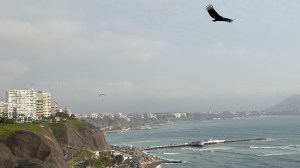
Our first day in Peru was easy with a tour of the city and a walk along the Pacific IMG_3624foreshore. Lima is working hard to develop itself into a modern city that will become a gateway for international tourism. There are lots of reminders of its colonial past and its more ancient history including stepped pyramids made of mud bricks.
IMG_3584


A flight from Lima to Cusco and we are now in the foothills of the Andes. When I say foothills we have just gone from sea level to 3200 metres. Everywhere there is information about altitude sickness and what you need to do to alleviate the symptoms of these altitudes.IMG_3747

The advice includes drinking lots of water and staying hydrated, eating chocolate covered coffee beans, drinking coco leaf tea, taking things easy and not rushing about. What nobody tells you is don’t open that bottle of aerated water you bought at sea level. Ignorance of this phenomenon and it will result in you wearing your water. This may have happened to me.IMG_3658

Peru is growing like the rest of the world and has a population of 30 mill. Cusco has grown in 40 years from 20,000 people to 500,000 people but still retains the look and feel of Peru.

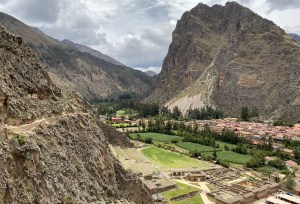
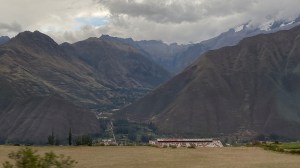
IMG_3727From Cusco we ventured further into the countryside arriving at our hotel in the Sacred Valley. It is something beyond 5 stars surrounded by high mountains and amazing gardens. The bathroom is the size of many of the hotels rooms we have frequented.
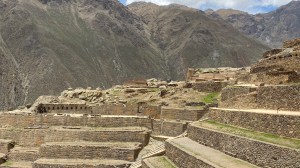
We have travelled beyond the Sacred Valley through many villages and towns to climb the Inca ruins of Pisaq.IMG_3716

To date we have sampled the Peru cocktail pisco sour which are excellent. We have also eaten ceviche which is raw fish cured in citrus juice and tonight alpaca which is something between beef and lamb. Whilst it has been offered we have not tried guinea pig which is served on a skewer.  Maybe there will be more opportunities to enjoy such local delicacies.

Tomorrow Machu Picchu.

Log Fifty Nine – 100 Years of Change in the Bush

24 August 2019

The title of this Log is an oblique reference to our experiences over the past week.

We have left the wide open spaces of the more distant country and are now in what seems to be suburban by comparison.  We are still a long way from home but the towns are bigger, the road trains have vanished, the farms are closer and the traffic is heavier.  When I say the traffic is heavier I can now see a car way out in front of me and a vehicle might pass me every few minutes.  Its practically peak hour out here.  The Brahman cattle are no more and the paddocks are more likely stocked with Hereford and Angus animals.

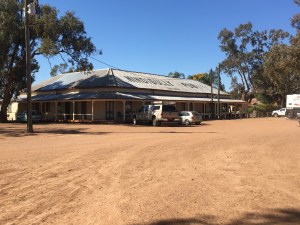
img_3379We made a brief stop at the Nindigully Pub.  This is Queensland’s oldest licenced pub.  It was first licenced in 1864, servicing Cobb and Co stage coaches and accommodating their passengers.  The pub has pretty much remained untouched since that time.  As you walk along the verandah you can almost hear the conversations of the drovers, shearers, farm workers and station managers that must have enjoyed a cold beer at this pub.
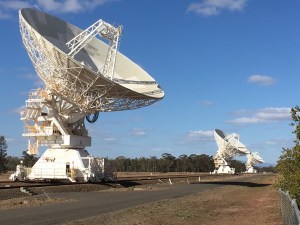
img_3380From Nindigully we reached Narrabri and visited the Australian telescope.  From pubs that serviced stage coaches we are now looking at radio telescopes that are looking at galaxies on the other side of our own Milky Way some 50,000 light years away. In a 100 years we have gone from stage coaches to radio telescopes analysing the universe.  Blows my mind.

After the satellite dishes we explored Mt Kaputar an ancient volcano.  Now this volcano was busy for 4 million years but stopped 17 million years ago, well before it was able to interfere with aircraft timetables.  Now 17 million years might seem a long time ago but to keep things in perspective the dinosaur footprints we saw in Winton were laid down 74 million years before the volcano even thought of spewing out lava.

We visited the town of Gunnedah which claims to host the biggest agriculture field day in Australia.  It is amazing with some 28 km of avenues to explore.  Again the technology changes in farming over the past 100 years is staggering. Of course with such a drought I don’t think there were too many sales happening.

Speaking of the drought we discovered that with no rain there are no trains.  The railways are empty.  A curious relationship but with no rain there is no grain and hence no trains to haul the grain.

Our final excursion before our return home was to the Western Plains Zoo.  Who doesn’t enjoy watching meerkats, lions, tigers, rhinos (fat unicorns) and elephants. A great day with lots of walking.

Tomorrow we head home for the obligatory unpacking, repairs (windscreen) and all the jobs that have been on hold for the past 8 weeks.  The next travel log will be from more exotic locations in a couple of months time.


Log Fifty Eight – An Oasis in the Savannah

17 August 2019


We have left the plains and have found our oasis.  What a change of scenery. Throughout the past days and weeks we have been driving across vast open plains dotted with small country towns and the odd sign to some massive open cut or underground mine.  We have been entertained by mobs of cattle being driven along the stock routes and have kept our eye out for massive road trains that frequent these roads.

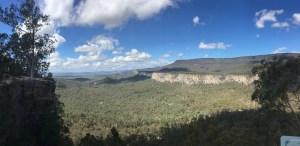
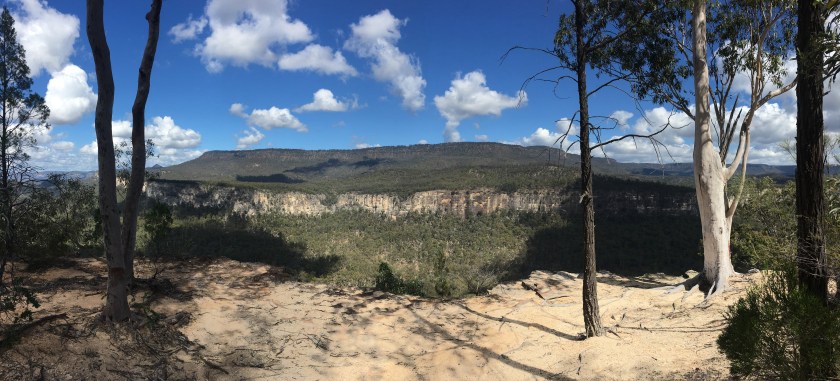
View from Boolimba LookoutWe have now reached an oasis in the true sense with forests, shady palm trees, and creeks that never stop flowing.  Carnarvon Gorge is a green gem hidden away in the sandstone escarpment that lines the horizon.  We have been here before, some 6 years ago when access was via 40 km of dirt road that included three creek crossings. Now the road is sealed and available to all those who ‘don’t do’ dirt roads.  It’s popularity grows.

We spent four days exploring the highlights of the gorge. From rock art estimated to be over 3,500 years old to tree ferns only found in this gorge and a few other places along the coast 100s of kilometres away.  These ferns only grow in running water which means the creek in which they grow has not stopped flowing in a very long time.

In the evening you can watch platypuses swim in the creek as you wonder how did they get here.  You have just driven across a dry open plain and then you find a platypus joyfully exploring the bottom of the creek looking for food.

The gorge includes a formation called the Amphitheatre which is a hollowed out section of the sandstone cliff.  To gain entry into the Amphitheatre you climb up a series of ladders and through a narrow gap in the cliff.  You are suddenly surrounded by huge cliffs and silence.  A place for quiet contemplation and your own thoughts.

The Moss Garden is dripping with water seeping from the sandstone.  The water is estimated to be 1000s of years old.  This water could have fallen as rain while the Egyptians were building the pyramids.  That blows my mind.

The EscarpmentA walk to the top of the escarpment offers a view of the gorge and out across the plains we will cross when we depart this exceptional place.
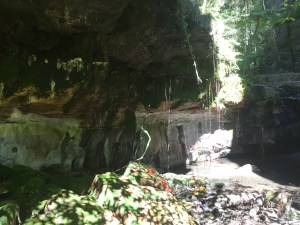
The Moss GardenWe are now heading south and toward home however we will delay the inevitable as long as possible.  We have reached country where it is no longer kites clearing the roadkill but common ravens (crows).  Road trains are becoming less common as we get closer to more populated country.
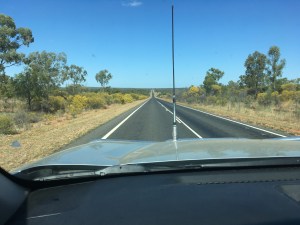
 

The windscreen has collected more chips and the crack continues to grow.  We have also just missed a steer that suddenly decided it wanted to be on the other side of the road.  It was almost a hood ornament.

One more week ……..


Log Fifty Six – Cattle with Attitude and Dressed Up Termite Mounds

10 August 2019

img_3329
Road north

Our northward traverse has ended.  We have now turned east and south.  We have passed through the town of Emerald where there are no emeralds and are now in Roma.  We have driven through the gold mining town of Charters Towers and the vast coal country of the  Galilee Basin.

Before we left Cloncurry we visited the site of the old Mary Kathleen uranium mine.  The open cut mine now looks like a most inviting swimming pool in the middle of a dry and stony landscape.  The vivid blue is thought to come from copper leaching from the rock walls.  This picture does not give justice to the blueness of this lake.  The mine closed in 1984 and the thriving town complete with school and swimming pool dismantled and sold off.


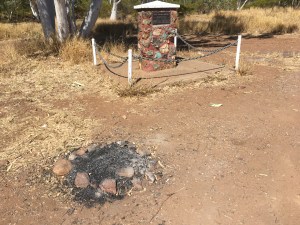
Along the way to the lake we came across yet another Burke and Wills memorial.  I can’t imagine the privations they faced travelling through this country in the middle of summer in 1861.  I was left wondering whether this is the remains of one of their campfires from 1861.

img_3303
Burke & Wills memorial campfire

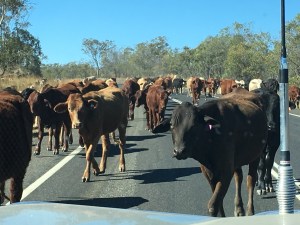
Along these roads it’s not uncommon to see herds of a 1000 plus cattle on the long paddock.  Out here these herds take priority.  Like the cows of India these guys have attitude and don’t move for anyone including large trucks. As you creep forward they just move around the car in their slow meandering pace.  Their drover masters on horseback in the background.

Speaking of large trucks, let me say the mind is focussed when you have a four trailer road train heading toward you on a rough piece of road.  Our most exciting moment was when the 4th trailer of one of these massive trucks was swaying across both lanes, twisting and distorting as  it went.  This was all happening at 100 kph.  It went passed us as we withheld our breath with our car as far to the left as was possible.img_3339

This country is very flat and largely empty.  Moments of excitement have come with the occasional bend in the road or even a hill.  This country is so flat that we crossed the great dividing range over an insignificant hill of 441 metres.  The Rocky Mountain it’s not.

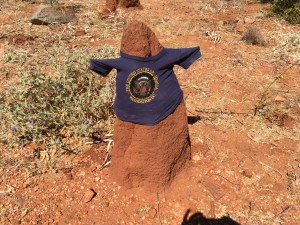
Travellers to these parts seek to entertain themselves in strange ways. There are many instances of termite mounds dressed in tee shirts, collared shirts and caps.  Its quite a sight to see hundreds of dressed termites mounds across the expanse of the bush.

img_3308
Washington DC termite mound

The architecture of the larger towns is also a surprise.  In days past Charters Towers was a gold mining town.  There were no fly-in-fly-out miners in those days and the main street reflects the wealth that was invested in the town.  Charters Towers even had its own stock exchange!  Today the display windows of department stores from the 1930s still survive.  The smaller towns boast shaded car parking in the main street.


There is a real shortage of skilled labour in these parts.  I was chatting with the caretakers at a caravan park, showing interest in their work.  Their response was to ask me ‘and what are you doing’  I think that was a job interview.  Today in the barber’s chair getting a haircut I hear from behind me ‘if you have truck licence there’s plenty of work, we can’t keep drivers’.  Methinks that was another job interview.  We will continue our travels.

The crack in the windscreen continues to grow at an alarming pace.


Log Fifty Five – Emptiness and Rodeos

4 August 2019

img_3282Our drive from Winton to Cloncurry  took about 4.5 hours through what is very empty country.  We drove through two towns that could claim a pub and petrol station and that was pretty much it. The town of McKinlay is the site of the Walkabout Pub which was made famous by the Crocodile Dundee movie.

We saw few cars and road trains and in general it was vast expanse of open, empty country.  The horizon was clearly visible from 360°.  A place you could navigate with the assistance of a sextant.

There were a few cattle around water holes and the country looked pretty good after the destructive floods of March this year.  It’s hard to imagine floods in country that is so dry and flat.

It was pure serendipity that we arrived in Cloncurry for the biggest event of the year – the Curry Merry Muster, a three day rodeo. Now a rodeo was not on our bucket list but this was an opportunity not to be missed.

Prior to the rodeo I completed the local Parkrun.  Rather than a manicured park this run was through thorny scrub with the odd horse grazing  in the bush.  There was one gate to be closed so the horses didn’t get out.  This was very much in the feel of this country.  The field of runners was small as most had been at the pub the previous night celebrating the first day of the rodeo.

We spent the day at the rodeo watching barrel races, calf wrestling, bull riding, bronco riding, and calf roping.  It was amazing to see what the little kids could achieve not to mention the riding skills of the professionals.  One dad led his three year old mounted on a horse around the barrels – too cute.  The little boy got an encouraging round of applause from the crowd.

We were obvious tourists wearing shorts, short sleeve shirts and the wrong hats.  We should have been wearing cattleman hats, jeans and western shirts.  Even my belt buckle was too small.  Regardless we felt very comfortable in the rodeo crowd.  From one day at the rodeo, we are now committed to listening to both country and western music.

Not sure that we will follow the rodeo circuit but it was a fun day.

img_3300My finally observation of this country.  The gardeners at the van park were challenged to clear up the garden beds.  Their creative approach was to use a fork lift to remove the weeds from what is very hard ground. Love the ingenuity.

Log Fifty Four -Sapphires and the Tropic of Capricorn

1 August 2019

We have left the coast and have headed west, largely along the Tropic of Capricorn.  This puts us in the tropics for winter, what can I say, the only way to enjoy winter.

img_3205Everything is huge up here, the length and frequency of the coal trains, the distances between towns, the size of the farming properties, the trucks, the hats, horizon and sky and even the Van Gogh paintings.  All the signs seem to be faded from the intense heat and sunlight and the area is so empty they list the names of the properties on road signs so you think the place is more populated than it really is.

img_3281After leaving the coast we visited the town of Emerald.  Now Emerald has no emeralds but if you drive out of town a little way you come to the town of Sapphire which does have sapphires.  Forget Rubyvale if you are thinking of rubys.

img_3208In Sapphire for $20 you can buy two coffees, a scone, jam and cream and a bucket of sand and gravel that might include sapphires.  They then teach you how to sift and sort your bucket of gravel. We scored a 3 ct sapphire but it was all fractured and worthless.  A lady who filled her bucket from the same pile as us uncovered a 3 ct gem quality stone worth over $1000.  Not bad for a $20 investment.  We had fun finding our dodgy sapphire and several zircons.img_3207

Before heading further west I discovered we had a flat tyre.  This was our second automotive challenge and there was more to come.

Travelling on a Sunday revealed just how quiet the Queensland country town can be.  They were all closed.  No opportunity for a coffee on this day of travel.  We were lucky to find a petrol station that was open and it offered a limited range of food for lunch.  Now these towns are about one petrol station big and if you are lucky there might be a pub.

img_3233At Longreach our time was divided between the Qantas Founders Museum and the Stockmans Hall of Fame, two cultural icons.   Every town around here has some claim for the foundation of Qantas either they were where the first board meeting occurred or they were the destination of the first flight or the original Qantas hanger was based at their airport.  Regardless, Qantas has very strong links with this remote part of Australia.  It’s quite a contrast from the high technology of a 747 jumbo jet to the vast open spaces of the cattle and sheep properties around here.

From the modern technology of flight we travelled to dinosaur country.  The area around Winton claims two major dinosaur museums. One full of very old bones of sauropods and the other fossilised footprints of a stampede that occurred one Tuesday afternoon in February 95 million years ago.  There are over 3,000 footprints of small dinosaurs in the stampede along with several prints from the predator chasing them.

I am always wary of claims that this is the ‘only one of its kind in the world’ however I am more confident this large scale display of so many footprints is pretty unique.  The other unique part of this visit is that to get to the stampede museum you have to drive over 100kms out of town primarily over dirt roads.  No masses of tourists that you might see at the terracotta soldiers or tour buses just a large tin shed in the middle of nowhere.img_3275

And the car now sports a very becoming crack across the windscreen compliments of a passing road train.


Log Fifty Three – Winter in the North

24 July 2019

A point of clarification for readers from the northern hemisphere – we in Australia head north for the sunshine in contrast to your need to fly south for winter.

We have successfully made it to Queensland and spent a week in Brisbane after a brief delay in Narrabri to complete a Saturday morning 5 km Parkrun.

I am trying to complete Parkruns in towns starting with the letters of the alphabet.  I have visited 11 different towns including two in the UK but I needed the letter N and hence the delay in Narrabri.  There will be many more Parkruns over the period of this trip.

img_3192After a week staying with family and catching up on 1st birthday parties and all the family gossip it was time to head north.  I also got to do another Parkrun this time in Zillmere.  I think there is only one town that starts with Z in Australia that has a Parkrun.  It’s a must do.

This time my sister and brother-in law joined us in our escape from the big city of Brisbane.

img_3199The further north we travelled the more winter was becoming a fading memory.  Regular checks of the weather sites reinforced for us that this trip north was more than justified considering the bleak temperatures our friends were enjoying at home.  I also had the irrestible urge to remind them of what they were missing via regular messages and emails.

img_3198We have been staying in 1770 for the past few days.  The town is so named after Jimmy Cook (Captain Cook to those less familiar with the navigator)  dropped in here 250 years ago.  Unlike the Hawiians the locals were happy for the short visit and for the English ship to continue on its journey without resorting to violence.  Of course we now have all sorts of laws and surveillance vessels to stop such foreign incursions of raggard foreigners turning upon our beaches.   These days Jimmy would probably claim to be an economic refugee escaping Brexit.

Our travels have taken us through that part of Australia where our tomatoes, lettuces and all sorts of ‘summer’ produce are produced all year round.  We now expect fresh mangoes, stawberries, tomatoes, lettuce, etc to be available regardless of the season.  This has it upside like dropping into a strawberry farm and buying a large tray of ‘second’ stawberries ie those the supermarkets reject.  We gorged for the next two days on oversized strawberries all for $5.00.

img_3184On our way to 1770 we stopped one night at a ‘free’ camp which was more like a parking lot, one block back from the main street of Childers.  Childers is a classic Queensland country town with three pubs in the main street, each one over a 100 years old.  It’s nice to see some of this Australian architecture still remaining.

img_3200We are now heading west to discover dinosaurs and Australian history so you can look forward to more ramblings in the coming weeks.


Log Fifty Two – There and Back Again

July 24, 2019

Two months of travel through the north to escape the southern winter.  Well that was the plan.  We were packed and on the road. Brisbane was our first destination which we would arrive at after two days of driving.  I was already thinking of my Planetrowe.com posts.

Alas, after a mere 300 kms of travel we were back home

The car went bang and I’m talking a very loud bang.  We pulled over.  Some hours later we were towed into the nearest town where we stayed the night.  The next day we drove a hire car home.  The car and caravan were towed home and the car taken to our mechanic.

After a delay of several days it turned out the problem wasn’t as severe as expected and some 6 days after the initial bang we were back on the road.

It’s hard to believe but again about 300 kms from home we had the second bang.  This time we knew what the problem was and the roadside assistance mechanic fixed the problem after a 1.5 hour wait on the side of the road.  We again drove to a local dealership who assured us the problem was fixed and so we headed off.

Two hours later ‘BANG’.  This time I knew what the problem was and how to fix it.  In ten minutes we were back on the rod.  So first time a week to fix, second time 1.5 hours, third time 10 minutes.  This is the learning curve in action.

We drove on to the next dealership in Dubbo NSW and booked the car in for the next day.  They squeezed us in and by 10.00 am we were back on the road with assurances they had really fixed the problem.

We drove away with some trepidation but I can report 2 weeks later the car is behaving.

For those with an interest in these things the hose from the intercooler to the turbo became disconnected hence the bang.  No real damage just a hose coming loose.  The things you learn.

One message I should share, if you have the option of premium level care for your roadside assistance take it.  In 40 years we have  never used this level of service until now and it was worth every cent.

One other observation.  The dealership reset our engine light via a WiFi connection to the motor.  Who knew the motor had a WiFi connection and what other info does the manufacture collect via WiFi?  I’m not paranoid, oh no.


Log Fifty One – Wilderness, Convicts and Devils, The Tasmanian Snapshot

March 1, 2019

As always you never have enough time to see everything and at the end of your travels you are left with the sentiment that I must return to see what I missed.  And so it is with our trip to Tassie. We have only skimmed the surface of this amazing place.  Some lasting memories:

Wilderness

Tasmania has its fair share of amazing wilderness with some 40% of its total area covered by National Parks. The Cradle Mountain / Lake St Claire wilderness area is only one of two parks in the world that meet seven out of the 10 key criteria for listing as a World Heritage site. They have lots of trees that are over 2,500 years old and one in particular that is 100 metres (330 ft) tall . And what is so unique is that they are still there and growing and haven’t all been cut down.

International Naming

Tasmania boasts a town called National Park and a seaside town called Penguin. Were all parks around the world named after this tiny town of one shop and a pub, I would like to think so. Similarly I think all short little fat sea birds have been named after the village of Penguin in northern Tassie. As you would expect there is a big penguin.

Tannin in the Rivers

Everywhere in Tasmania the rivers run a chocolate brown colour. This is from the tannin that leaches from the native vegetation. I had to explain this to a couple of international tourists who commented that where they came from brown water was usually toxic and full of industrial pollutants. They were rather relieved with my explanation.

Convicts

I try to avoid measuring behaviours of the past with our values of today however at any reckoning the treatment of the convicts was brutal.

At Port Arthur convict penitentiary there was a cell where the walls are so thick there was no sound and no light could enter. The cell was designed for total sensory deprivation. Men would go mad in this cell.

Sarah Island is a tiny speck of about 5 acres in the Macquarie harbour on the west coast of Tasmania. You couldn’t find a more remote and inhospitable piece of land. It is windswept, wet and freezing cold. Down here you are getting closer to Antartica than the tropics of Australia. The men were despatched to Sara Island as a punishment. Worse yet the female prisoners were put on a nearby island which was even smaller and more bleak. The women did have a cave to sleep in but of course only at low tide because at high tide the cave flooded.

I guess in those days the concept of human rights hadn’t quite reached the conceptual stage.

The convicts have certainly contributed to the tourism appeal of Tasmania with the colonial architecture in Hobart and the rural towns and villages. You have to wonder what Tasmania would be without the convict history. Just think what the USA missed out on by rejecting the English attempt to send more convicts their way.

The Best Things About Tasmania

The food, wine and single malt whisky. This includes their famous scallop pies.

Temperate rainforest wilderness.

Amazing trees both ancient and tall. They have the tallest flowering hardwoods in the world.

Wooden boats.

Colonial towns and villages.

Quiet roads and no real traffic.

A pace of life that is a step back.

Tasmanian devils. They are so well named and you would never call a young devil Bambi, Fluffy or Snuggles.

Final Words:  What Not to Say in Tasmania.

It’s the ‘River Derwent’ not the Derwent River! Launceston is pronounced Lonceston, do not pronounce it Lawnceston.

Log Fifty – Tasmanian Travels

16 February 2019

This the first of my ramblings for 2019 and the first from Australia in nearly two and a half years. While this adventure might still technically be overseas I am not sure an overnight trip on a ferry to Tasmania qualifies for a true ‘overseas’ experience.

We are now in the land of Tasmanian Devils, wooden boats, wilderness and amazing food of all descriptions.

Crossing Bass Strait

Being an island there are but three options to get here; you are born in Tasmania, you fly or you travel by boat. We chose to travel on the ferry with our car and caravan.

As with all ship travel at some stage there is the obligatory safety briefing. As expected we were given an explanation on how many blasts of the siren indicated we should proceed to the muster stations and how many indicated abandon ship. Of course this would never happen. We went to sleep in our cozy but comfortable cabin on very calm seas.


Some two hours later I am awoken and all I can hear are blasts from the ship’s horn. OK, you have my attention; does this mean off to my muster station in my PJs or what? Bass Strait will be bloody cold in my PJs. Just a second how many blasts on the siren meant muster stations; I think it was seven. My counting in my half awake state is something like six, seven, eight, nine……….fifteen, sixteen….. Just a second wasn’t it seven blasts and now we are at twenty two. This is not muster stations it’s probably another ship in our way. No need to panic, go back to sleep, no proceeding to the ship’s lounge to see what everyone else wears to bed; not tonight.

We arrived next morning in the port of Devonport after a very relaxing crossing with no ill effects or even a hint of motion sickness.

Wooden Boat Festival

The prime motivator for this trip was the Hobart Wooden Boat Festival that only happens every two years. Now I am not about to get into boating and certainly not a wooden boat and all the work that is involved. No my interest is purely in the beauty of wooden boast, their history and the craftsmanship that goes into building these craft.


Scallop Pies

We were determined to sample the legendary Tasmanian scallop pies. Our first attempt ended in disappointment when told the purveyor had sold out. All was not lost as we were assured nine cases of pies had been delivered to another outlet and he was sure to have plenty of the sought after pies.

We set off across the harbour to find the man who was ‘sure’ to have pies. Yes, you guessed it he had also sold out. We accepted this as it was just after lunchtime. So tomorrow we would be back and the successful purchase of the pies would be assured.

Next day we headed straight to the pie man only to be told he had already sold out and it wasn’t even lunchtime! Damn it do these pies exist? Maybe we are in the scallop pie version of the Monty Python cheese shop scene?

The wooden boat festival ended without us scoring a scallop pie.

Fortunately our travels took us to the remote south of Tasmania where we were confident scallop pies would be found. Success at last, a restaurant come coffee shop in the village of Geeveston proudly advertised scallop pies. Failed again, no pies, the shop was closed; we were too late.

Back the next day we finally scored our scallop pies. Bliss and joy, and they were well worth the wait.

Scallop pies are something all traveller’s to this island should sample. I was however starting to think scallop pies had gone the way of the Tasmania Tiger, extinct.

Toilet Story

As I have previously said all good travellers’ tales require a toilet story. True to form this trip has its obligatory loo story.

We visited a road side loo that obviously used the nearby creek water for flushing. Unfortunately the creek water was deeply coloured by the tannins from the vegetation. Yes, the water was a chocolate brown. I’ll say no more except to say it was rather disconcerting.

Seahorse Centre

We have visited one of the very few sea horse breeding centres in the world. I am not sure what the world does with the thousands of sea horses bred at this centre but it was fun to see such numbers of the little creatures and to have the them twist their tails around your finger.

Did you know the sea horse is one of the few animals where it is the male that gives birth to the young. I am not sure what evolutionary quirk caused the males of this species to think birthing the young would be a good idea and that they should do it in preference of the females. I am glad they did not become role models for all other males.


Mawson’s Hut

In Hobart there is a wonderful replica of Doug Mawson’s hut. This is a full scale replica of the hut seventeen men lived on Antartica for three years around 1911. Consider the living conditions: the men were lucky to bathe every 18 days, they ate seal and pengiun and no fresh fruit or veggies, the hut never got above 4c (39f) and the average outside speed was 70 kph (44 mph). The smell of all those wet woollen garments and the body odours must have been something to behold and for three years!


Convict Labour and Colonial Villages

After the American war of independance some 70,000 government sponsored boat people arrived in Australia. These were the ‘convict’ years. There early immigrants were out to work cutting timber, mining coal, clearing the land, boat building and building townships. The efforts of these ne’er-do-wells are everywhere to be seen across Tasmania especially in the construction of bridges and colonial villages and towns. Many of these buildings are now coffee shops and bakeries. When you come to Tasmania come prepared to eat and drink well.


More to come……