19 November 2019
After Lake Titicaca we had one night in Lima and then back to the airport for a flight to Calama, Chile. Our bus driver had somewhere else to go so it was a quick drive through the Sunday morning streets of Lima. What would normally take 1 hour on a good day took 45 minutes on this trip. Maybe an appreciation of the Dakar rally would have allowed me to understand what a heavy vehicle can achieve in the right hands.
We arrived in Calama and were back at 2400 metres. Now Calama has one claim to fame and that’s copper mining. Its a dusty modern city in the middle of a bone dry desert. Not a blade of grass, tree or scrub in sight.


We were immediately despatched to San Pedro de Atacama. This town of about 11,000 people looks like it is straight from the Star Wars tone of Tatooine The town is built in an oasis and is surrounded by desert. The streets are narrow and dusty, the building predominantly built of adobe. The town is a buzz with travellers from all over the world here to experience the Atacama.
At about 3000 metres the conditions here are somewhat extreme. The air is bone dry, the UV rating is through the roof and the skies clear. In some parts of the Atacama rain hasn’t fallen for thousands of year. Its dry! Exposure to the sun for only a few minutes and you can feel yourself turning into a desiccated version of what you were at sea level.
Our accommodation was in a hotel that truely reflected the desert environment and complimented the adobe architecture of San Pedro. The rooms opened onto their own courtyard and the pool was a pleasure after a long day of travel.
Our exploration of these high altitudes commenced with a visit to the oasis village of Toconao. This a small village that has existed for hundreds of years thanks to a ready supply of water from the surrounding mountains. Whilst irrigation channels provide for lush gardens and the orchards where the water stops then the extreme wasteland of the desert starts. There is no soft border between garden and desert.
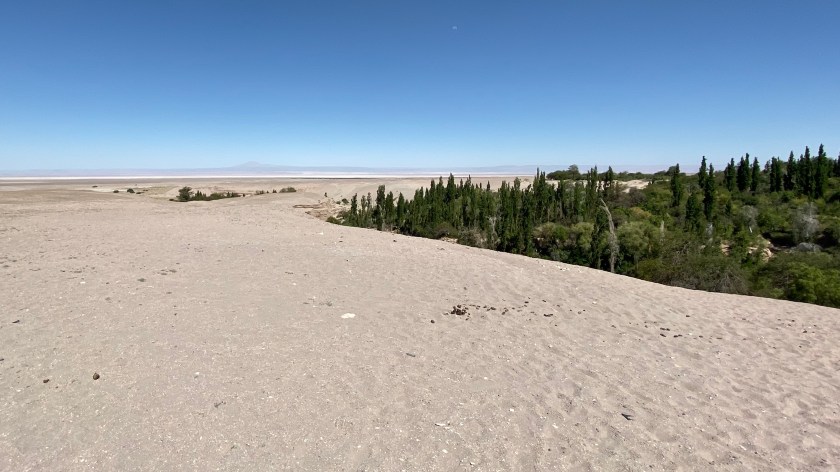
After the oasis village it was the vast Atacama salt flats that was our focus for this part of the adventure. These salt flats extend 100km long by 80 km wide or 3,000 sq km of salt. Regardless of the SPF50 sun screen you are wearing, along with long trousers and long sleeve shirts and sun glasses you can still feel the heat and dryness sapping the moisture from your body. But we were here to see the Andean flamingoes. And they were there, feeding on the brine shrimp in these caustic waters. There is the Jame’s, the Andean and the Chilean flamingoes all feeding in the same lagoon.


Later in the day we walked the tracks of Moon Valley and enjoyed a glass of wine as the sun set over the Atacama desert and the high Andes. Moon Valley is the closest representation on earth of what the martian landscape might be like. Rocky cliffs, wind borne dust and stunning sand dunes. I couldn’t imagine any life form surviving in this place but we know that’s not the case. There are Andean foxes, lizards, and birds surviving in these extreme environments.


You run out of superlatives in trying to describe the magnitude and vast spaces that make up the Atacama desert.

 A Traveller's Tale