
28 March 2017
Our travels through Rajasthan continue.
The Patina of India
Some might call it grime rather than patina but India does have a look and Dorothy we are not in Kansas anymore. This is a very dry region but you can’t help but feel you could do so much with a high pressure steam cleaner.
The countryside has a dry bleached look which I am sure changes in the wet season when the monsoon arrives. However, in this haze of dust there are flashes of brilliant colour. Reds, blues, yellow, gold and silver. These are the saris worn by the women walking through the villages, in the fields and along the roads. A complete contrast to the general background; coloured gems in a swathe of gravel.
Rubbish
It’s everywhere and it’s probably one of the things that is the most confronting. It’s in the villages, on the roadside, hanging from trees, in dry river beds, in the fields, everywhere.
Everything has a use. Even off cuts and waste from the marble processing works are recycled as dry stone walls. In the marble mining areas, you find miles and miles of pure white dry stone walls that are perfectly straight and square.
Slabs of sandstone that might have become paving are recycled as fences around fields. Waste from the granite and sand stone mines also becomes dry stone walls.
Maharajas and Maharanee
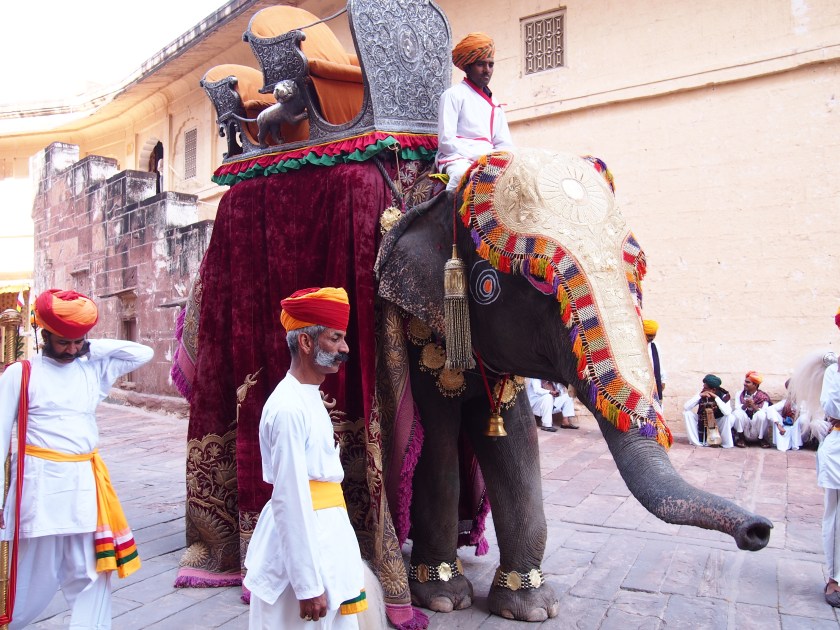
It seems the ruling class was occupied by four main activities they were:
Shooting tigers – there are pictures everywhere in the hotels of safaris and hunting parties with dead tigers and panthers.
Fighting your neighbouring Maharaja – seems conquering more land from your neighbour was the prime business of the day.
Looking after your many wives and 100s of concubines – fortunately owning a massive fort ensured you had plenty of rooms to keep the various parties well separated and each in their own luxurious setting.
Building massive forts or palaces – the forts are stunning. They are huge and have been occupied for hundreds of years. Many are now hotels.
The owner of one particularly magnificent fort had the architect buried alive in the foundations so no one could discover the secrets of the fort. Probably seemed reasonable at the time. We would have put the floor plans in a vault.
Men and women
Women are in the fields cutting wheat by hand and doing manual labour, even loading sand trucks using baskets. Jobs like waiting tables for tourists or managing the reception desk at the hotel are all done by men.
Women do the gardening at the hotel and often cover their face when we pass. The fear is someone in their village will gossip about them being uncovered in front of westerners.
Toilets and Bathrooms
It’s Asia I’ll say no more.
Cows
They seem to wander aimlessly without anyone caring for them, yet they are owned by individuals. Each morning they will leave their owner’s house and wander the neighbourhood getting a small amount of feed at each house they visit. Being sacred those that feed the cows receive a blessing. At the end of the day the cow finds its way back to its owner’s house.
It’s the job of the untouchables to remove any carcasses, and to remove the hide before burying the cow.
Newspaper Journalism
The writing style is in a unique conversational style of English. The police are always the ‘cops’. Politicians are reported as VVIP which I assume means very very important people.
An Udaipur newspaper reported the death of an individual and how their organs had been donated for transplant. The report then went on to list the names of the patients and what organs they received. Along with their name, their age and their city were included in the report. Never would happen in Australia.
That’s it for now. More reports to come as we visit Jaipur, Agra and New Delhi.
 A Traveller's Tale